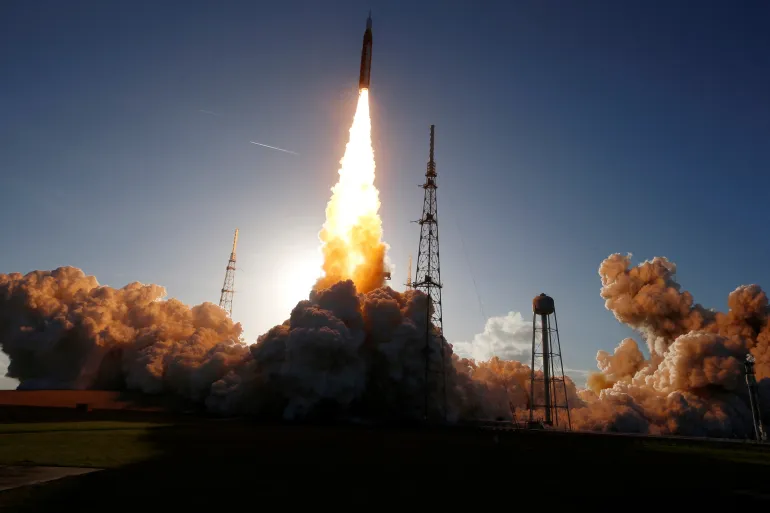
NASA's Artemis II lifts off from the Kennedy Space Center in Cape Canaveral, in Florida, the US. Photo/Reuters
Newsflash and Agencies
The Artemis II successfully launched from the US state of Florida, sending four astronauts on a landmark journey around the moon and marking humanity’s return beyond low-Earth orbit after more than five decades.
The mission, which lifted off on Thursday, April 2, 2026, represents a crucial milestone for NASA as it pushes forward plans to return humans to the lunar surface and eventually undertake crewed missions to Mars.
The towering 32-storey rocket blasted off from the Kennedy Space Center, drawing tens of thousands of spectators who gathered to witness the historic moment.
The Artemis II crew—Reid Wiseman, Victor Glover, Christina Koch, and Canadian astronaut Jeremy Hansen—will embark on a nearly 10-day mission, venturing farther into space than any human crew in recent decades.
“This mission carries the spirit of a new generation and the shared ambition of global partners,” said launch director Charlie Blackwell-Thompson as the spacecraft lifted off.
Minutes into the flight, commander Wiseman confirmed visual contact with their destination, noting the crew had a clear view of the moon as they began their journey.
Pre-launch tensions
The hours leading up to liftoff were marked by heightened tension, particularly during the fueling process. Engineers closely monitored the loading of more than 700,000 gallons (2.6 million litres) of hydrogen fuel into the Space Launch System rocket, a phase that had previously caused a dangerous leak and forced delays earlier in the year.
Read more: Rwanda to unveil Africa’s first self-flying electric air taxi
This time, however, the process proceeded without any major issues, allowing the mission to stay on schedule.
NASA teams also addressed several technical concerns ahead of launch. Among them was a temporary fault in the rocket’s flight-termination system, which is designed to destroy the rocket if it veers off course. Engineers resolved the issue swiftly.
Another concern involved a temperature irregularity in a battery within the Orion capsule’s launch-abort system. After thorough checks, the problem was fixed and cleared for flight, ensuring the mission could proceed without interruption.
Inside the journey to the moon
Following launch, the astronauts will spend the first one to two days orbiting Earth while conducting detailed system checks. These include testing the Orion spacecraft’s life-support, propulsion, navigation, and communication systems to confirm readiness for deep space travel.
Once verified, the spacecraft will execute a critical manoeuvre known as translunar injection, propelling it out of Earth’s orbit and onto a trajectory toward the moon.
Over the following days, the crew will continue monitoring onboard systems as they travel deeper into space. The spacecraft will then pass behind the moon along a free-return trajectory, allowing lunar and Earth gravity to guide it back home with minimal fuel use.
This phase will also mark the farthest distance humans have travelled from Earth in decades.
Return to the earth
After completing the lunar flyby, the crew will begin their journey back, conducting further tests on onboard systems including power, thermal controls, and crew operations.
As the Orion capsule re-enters Earth’s atmosphere, it will reach speeds of about 40,000 kilometres per hour before descending into the Pacific Ocean, where recovery teams will retrieve the astronauts.
Read more: AMREF identifies staff killed in Mwihoko plane crash
With more than half of the world’s population born after the Apollo program, Artemis II is being positioned as a defining mission for a new generation.
“This is their Apollo,” said NASA science mission chief Nicky Fox, highlighting the renewed global excitement surrounding human space exploration.


About the Author