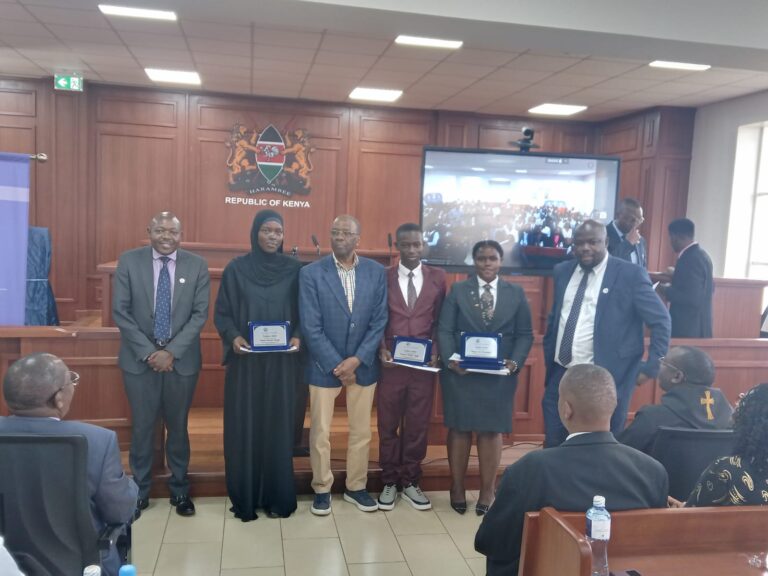
Education Cabinet Secretary Julius Ogamba with officials of The African Talent University (TATU) while he was handing them a Letter of Interim Authority (LIA). Photo/MoE
By Newsflash Reporter
The African Talent University (TATU), located in Kisumu, has officially been granted approval by the government to begin admitting students, marking a significant milestone in Kenya’s higher education sector.
With this development, TATU becomes the country’s 85th university and stands out as the only institution fully dedicated to talent-based learning.
Education Cabinet Secretary Julius Ogamba issued the institution with a Letter of Interim Authority (LIA) on Monday, April 20, following approval from the Commission for University Education (CUE).
This authorization allows the university to commence operations as it works towards meeting the requirements for a full charter.
A new model of learning
TATU distinguishes itself by offering a non-traditional approach to education, focusing on nurturing individuals whose strengths may not lie in conventional academic performance. The institution aims to develop skilled professionals by identifying and cultivating talents often overlooked in standard academic systems.
Dr Ogamba described the university’s establishment as a progressive move toward creating a more inclusive and responsive education system.
Read more:Nyandarua to get its first ever University

He emphasized that the initiative aligns with the government’s broader goal of expanding access to higher education and recognizing diverse forms of intelligence and ability.
“This reflects our commitment to broadening opportunities, nurturing talent in all its forms, and ensuring university education remains relevant to the realities of today,” Ogamba stated.
Addressing access gaps
The Cabinet Secretary noted that the approval of TATU comes at a time when Kenya faces increasing demand for university education. Current data shows that only about 28 percent of the more than 900,000 students who sit national secondary school examinations each year proceed to university.
According to Ogamba, this gap highlights the urgent need to rethink how universities operate and whom they serve. He pointed out that future institutions must evolve beyond traditional lecture-based systems to become centers of innovation, research, digital advancement, and enterprise.
He added that universities like TATU represent a shift toward more dynamic learning environments that better equip students for modern challenges and opportunities.
Bridging the competency gap
TATU founder Professor Humphrey Oborah described the institution as a transformative force in the education sector, particularly in addressing shortcomings within the Competency-Based Education (CBE) framework. He stressed the importance of moving away from evaluating learners solely through grades.
“We want to ensure that students are not judged purely on academic scores, but that those with natural abilities and unique potential are equally recognized and given opportunities to thrive,” Oborah said.
A long-time advocate for inclusive education, Oborah criticized traditional systems for narrowly defining intelligence through standardized testing. He argued that such approaches often overlook critical abilities such as creativity, innovation, leadership, entrepreneurship, and artistic expression.
Read more:Keep off education matters, MKU Chancellor Gaitho tell politicians
The launch event was attended by key stakeholders, including Higher Education Principal Secretary Beatrice Inyangala, officials from the Commission for University Education, and representatives from the Kisumu County Government.
Following the issuance of the LIA, TATU is now required to establish its governance structures, develop infrastructure, and build academic capacity under the supervision of the Commission for University Education.
The institution has up to eight years—renewable once after four years—to meet the standards necessary for the award of a full university charter.



About the Author