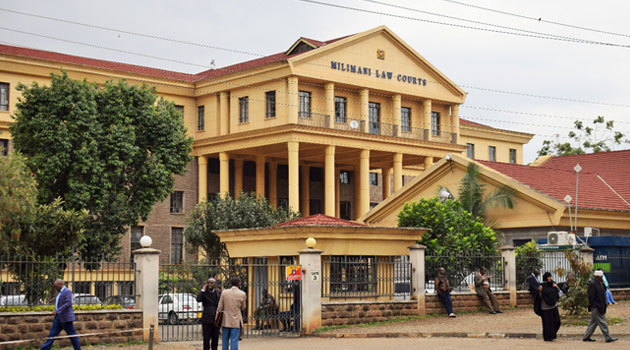
A file of the Milimani Law Courts, Nairobi. Photo/Handout
By Newsflash Writer
The government’s ambitious plan to raise at least Sh5 trillion for roads, rail, ports, and energy projects has been temporarily halted by the High Court, raising questions about the legality and oversight of the National Infrastructure Fund (NIF).
The court issued conservatory orders freezing the fund, citing serious constitutional concerns raised in two separate petitions. This ruling forces the government to pause a flagship financing initiative that President William Ruto described as a crucial step toward transforming Kenya into a “first world country.”
The High Court barred all steps to establish or operationalise the NIF, including incorporation, registration, and funding. The judge directed State agencies to refrain from “establishing, incorporating, registering, operationalising, funding, or howsoever otherwise giving effect” to the NIF pending full hearings. The move came after petitions by Dr. Magare Gikenyi, Eliud Karanja Matindi, and two others, alongside a separate case by the Consumer Federation of Kenya (Cofek). Respondents include the Attorney-General, the Cabinet Secretary for the National Treasury and Economic Planning, and offices responsible for auditing and budget oversight.
Read more: Gov’t to upgrade State House Road in Nairobi at Sh1.6 bn
Petitioners argue that the fund was being created through executive action without parliamentary approval, violating the Constitution and the Public Finance Management Act. They challenged a State House announcement that the NIF would be set up as a limited liability company, asserting that a national public fund cannot be established in this manner. Article 206 of the Constitution, they contend, requires that national government funds be established through an Act of Parliament or under the Public Finance Management Act. The court agreed that such constitutional concerns warranted protection before the fund could proceed.
Constitutional and oversight concerns
In the Cofek petition, the court issued similar orders restraining respondents from implementing the fund until the matter is fully heard, noting the link to the Gikenyi case. At the center of both petitions is the government’s plan to mobilise up to Sh5 trillion for infrastructure projects by pooling State assets, domestic savings, and private capital. The strategy also involves monetising mature public assets to finance priority projects while reducing reliance on borrowing and taxation.
Critics warn the approach could bypass parliamentary oversight, weaken public accountability, and create a parallel financing structure outside normal budgetary controls.
Read more: STEM dominates Grade 9 senior school placements
Petitioners also argue that the government failed to conduct public participation, denying Kenyans a voice in a fund with the potential to mobilise trillions of shillings. Additional concerns include governance, transparency, duplication with existing funds such as the Equalisation Fund, and the risk of asset stripping through “strategic monetisation” of public assets.
The court focused on preserving the status quo rather than ruling on the merits of these arguments, granting conservatory orders in the public interest. Petitioners must serve all parties by December 29, with responses due by January 9, ahead of a virtual highlighting on January 20. For the government, the ruling is a temporary setback, with the next phase set to determine whether the NIF can be legally anchored, restructured to meet constitutional standards, or abandoned entirely.


About the Author