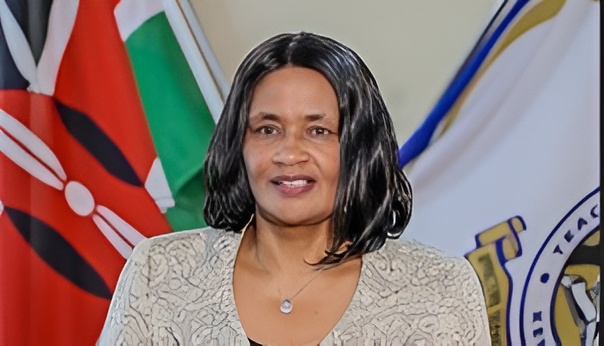
Acting TSC CEO Evaleen Mitei. Photo/TSC
By Newsflash Reporter
The Teachers Service Commission (TSC) is recalibrating its recruitment strategy by prioritising Bachelor of Education Technology graduates to staff the new Senior School level under the Competency Based Education (CBE) system.
TSC Director of Quality Assurance Dr Reuben Nthamburi said the shift is intended to address the specialised instructional needs of CBE, particularly its practical and technically oriented pathways. “The Bachelor of Education Technology (B.Ed. Tech.), such as the programme offered at Moi University, has now become crucial for the commission,” Dr Nthamburi said.
Focus shifts to technical pathways
Dr Nthamburi noted that B.Ed. Technology graduates have not been absorbed for a considerable period, even as the country grapples with an acute shortage of teachers in technical subjects. The gap is most pronounced within the Science, Technology, Engineering and Mathematics (STEM) pathway. According to TSC data, Senior School will require a large pool of specialised educators to effectively roll out the new curriculum. The STEM pathway alone is projected to take up about 60 per cent of the 1.1 million learners, translating to roughly 677,144 students, and will need an estimated 35,111 teachers across 15,046 classes.
Read more: Intern teachers’ hopes crushed as TSC extends contracts
The Social Sciences pathway will require 14,630 teachers, while the Arts and Sports pathway will need about 8,778. The B.Ed. Technology degree is tailored to provide the technical and practical competencies required in the STEM and other specialised pathways, positioning its graduates as critical to the successful implementation of CBE. Even as TSC races to plug technical teaching gaps, it acknowledges a growing unemployment crisis among humanities graduates. Dr Nthamburi cited the overwhelming response to vacancies in non-technical subjects, noting that a single History and Christian Religious Education (CRE) position can attract up to 5,000 applicants. He called on universities and teacher training colleges to reassess their programmes to better align graduate output with labour market needs.
Thousands registered, few employed
“How do we help so that we have a balance?” Dr Nthamburi posed. He explained that TSC currently has more than 900,000 teachers registered to teach in primary, secondary and Early Childhood Development (ECD) levels, yet only 434,337 are in active employment. This figure includes a substantial number of registered but jobless primary school teachers, some of whom are aged 50 years and above. ECD employment, however, is a devolved function and falls under county governments.
Read more: TSC recovers Sh222.3m in overpaid salaries, audit reveals
Dr Nthamburi added that teachers’ unions and headteachers’ associations recently raised concerns at State House during a meeting with President William Ruto, particularly regarding unemployed teachers aged over 45. “The President asked for data on teachers aged 45 and above, and we have since established that there are many who are registered but still unemployed,” he said.
Exporting teachers, schools still strained
In response to the growing pool of unemployed educators, TSC has developed a policy aimed at facilitating teachers to seek opportunities abroad. “We have come up with a policy to export teachers, and we have agreed that unemployed teachers should be supported to pursue opportunities in various countries,” Dr Nthamburi said.
Despite the large number of registered teachers, many public schools remain understaffed, forcing institutions to rely heavily on Board of Management (BoM) teachers whose salaries are paid by parents. In some cases, schools employ as many as 20 BoM teachers.
Read more: KNUT gives TSC one-week ultimatum after salary talks stall
Dr Nthamburi recalled that Education Cabinet Secretary Julius Ogamba recently visited a school in the Coast region and found 20 BoM teachers being paid directly by parents.
This situation underscores the persistent mismatch between the number of trained teachers graduating from universities and teacher training colleges and the limited positions TSC can finance. Current staffing levels show 220,181 teachers in primary schools, 129,847 in secondary schools, 52,000 permanent and 20,000 intern teachers in junior schools, 1,338 in teacher training colleges, and 59 at the Kenya Institute of Special Education. Additionally, a recent TSC census revealed that 110,920 teachers are employed in private institutions across the 47 counties.


About the Author