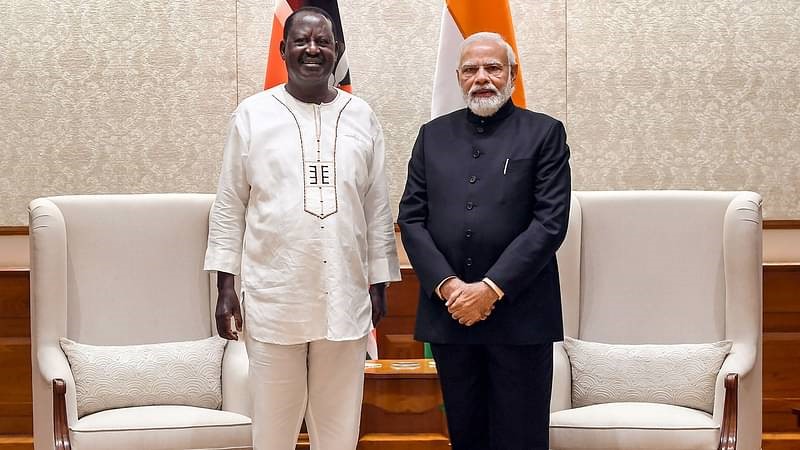
Former Prime Minister Raila Odinga and India’s Prime Minister Narendra Modi after being introduced to Gautam Adani. (Photo/Courtesy).
By Daisy Okiring | Nairobi | June 20, 2025 – 1:03 PM
Former Prime Minister Raila Odinga has broken his silence over the collapse of the multi-billion shilling Adani deal that was expected to transform Kenya’s infrastructure. Raila revealed his disappointment, stating that the failure of the agreement was a major setback for the country’s development and Nairobi’s ambition to become a regional economic powerhouse.
Speaking during the National Executive Retreat in Karen, Nairobi, Raila said the Sh637 billion deal between the Kenyan government and India’s Adani Group would have revitalized the Jomo Kenyatta International Airport (JKIA) and the Kenya Electricity Transmission Company (Ketraco). Under the agreement, Adani was to manage and expand JKIA and Ketraco for 30 years.
“I was very disappointed when we were not able to move on with the airport contract — that was very unfortunate,” Raila said.
He explained that the original JKIA expansion deal was awarded during the grand coalition government he led with the late President Mwai Kibaki. However, the contract was canceled after they left office. Although the same contractor was later re-engaged, the project was again terminated due to internal disagreements.
Also Read: Police brutality: Cracks emerge in Ruto-Raila alliance
The Adani deal was eventually shelved after becoming heavily politicized. President William Ruto is reported to have ordered its cancellation, citing transparency concerns.
Raila warned that the continued politicization of critical infrastructure projects could see Kenya lag behind neighbors like Ethiopia and Rwanda. “If nothing is done, Nairobi will just become dormant. Addis Ababa is building a new mega airport. Kigali is also advancing. If we delay, Nairobi will lose its competitive edge,” he cautioned.
The proposed JKIA expansion alone would have cost Sh238 billion. Raila emphasized that Kenya Airways (KQ) does not need to be profitable for the airport project to succeed. “Airlines like Emirates don’t always focus on profit — they bring in tourists, investors, and shoppers. Nairobi can do the same with a modern airport,” he added.
He concluded that infrastructure investments like these are crucial for positioning Kenya as an economic and travel hub for Africa.


About the Author