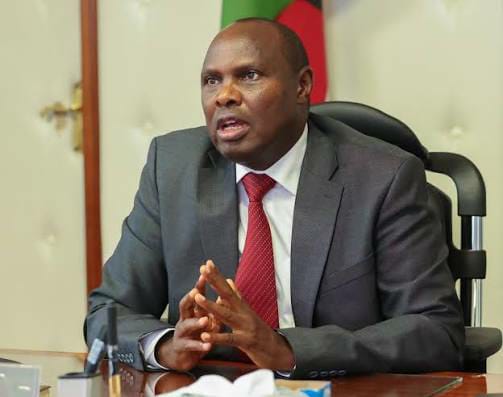
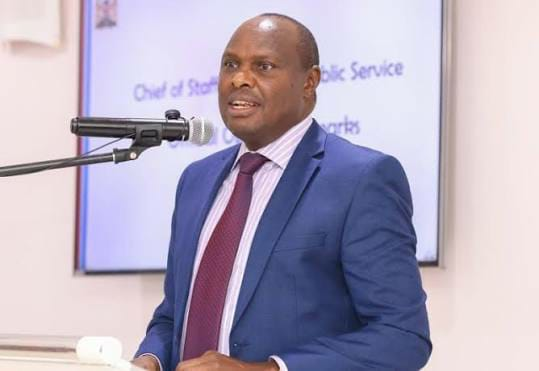
Mr Felix Koskei, Head of the Public Service. Photo/Courtesy
By Lawrence Ongaro
Kenya requires a comprehensive mapping of its oral health workforce across all 47 counties to address disparities in access to care, Chief of Staff and Head of the Public Service Felix Koskei has said.
With approximately 0.27 dentists for every 10,000 people — roughly one dentist for every 37,000 Kenyans — the country cannot meet its oral health needs through dentists alone.
“Nor can we answer a problem of unequal access merely by increasing national totals while leaving the same communities beyond the reach of care,” he said.
Kenya began training Community Oral Health Officers in 1985 to complement dentists. Today, approximately 1,800 officers represent a considerable national investment in a cadre designed to bring preventive, promotive and basic clinical care closer to the people.
Mr Koskei said mapping the country’s oral health workforce would provide an updated picture of staff distribution and their working conditions.
“We need to know who is serving, where they are serving, the populations they cover, the level of care at which they work and the infrastructure necessary for them to succeed. From that evidence must emerge clear staffing norms, an equitable deployment framework and a funded plan for implementation,” he said.
Integrating oral health services
He said Community Oral Health Officers should be integrated across the health system, from Level 6 referral facilities downwards, with particular emphasis on Levels 2, 3 and 4.
“This is the front line at which prevention, early detection, basic treatment and timely referral can have the greatest effect. This does not diminish the dentist. It allows every cadre to work at the height of its competence within a coherent and complementary system,” he added.
Read more: Teachers raise concerns over SHA Health Scheme shift
The Head of the Public Service spoke during the 32nd annual scientific conference of the Oral Health Association of Kenya (OHAK), held at Lake Naivasha Resort in Nakuru County. The three-day conference ended on Friday.
OHAK has more than 2,000 members.
“For too long, oral healthcare has occupied the margins of public health policy — noticed when pain becomes unbearable, funded when disease has advanced and sought when prevention has already failed. I challenge OHAK to become not only the voice of a profession, but the conscience of the oral health system. Speak with authority, but also with evidence,” he said.
Mr Koskei said the Social Health Authority (SHA) presents the sector with an important opportunity to bring oral healthcare from the periphery to the centre of health financing.
“OHAK must engage that process with both courage and evidence. Preventive services, screening, early intervention and basic restorative care must be treated not as optional additions, but as essential protections against disease and financial hardship,” he added.
Call for better planning and support
The Head of the Public Service said this year’s conference theme, “Elevating Oral Health Care, Excellence, and Expertise,” calls for more than professional reflection.
“It has summoned us to a higher standard of public duty. Excellence cannot remain a word displayed on a conference banner. It must become the ordinary experience of the citizen who walks into any health facility in Kenya,” he said.
Mr Koskei urged oral health workers to defend professional standards and the public interest.
“Advocate for your members, but never lose sight of the patient who has no platform, no title and no voice in the rooms where policy is made,” he said.
He also challenged the national Government, county governments, training institutions, regulators and development partners to prioritise staff welfare.
“A health worker cannot be asked to deliver excellence inside a system that withholds the conditions for excellence. We must match responsibility with tools; training with opportunity; deployment with infrastructure and public expectation with institutional support,” he cautioned.
Mr Koskei said oral health should no longer be treated as an afterthought in Universal Health Coverage and that no professional trained to serve should be rendered idle by poor planning.
Read more: Oral health workers told to maintain medical ethics
“No facility shall bear a mandate it has not been equipped to discharge; no county shall be invisible in the distribution of care and no Kenyan shall endure preventable oral pain merely because of where they were born, where they live or what they earn,” he said.
He advised oral health professionals to focus on preventive rather than predominantly curative care; community-based rather than facility-bound services; equitable rather than concentrated provision; integrated rather than isolated systems; and accountability for results rather than satisfaction with intentions.
“The Office of the Head of the Public Service stands ready to support stronger coordination, evidence-led workforce planning and accountable public service delivery. But the momentum must be carried by all of us. Government must listen. Institutions must act. Professionals must lead and citizens must feel the difference,” he told the conference.


About the Author