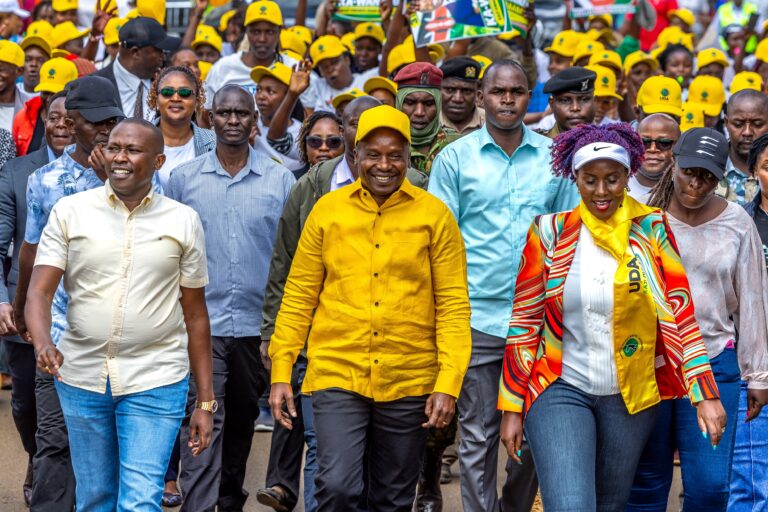
CSs William Kabogo (ICT), Mutahi Kagwe (Agriculture) and Lee Kinyanjui (Trade). Photo/Newsflash
By Wanderi Kamau
Fear and uncertainty have gripped President William Ruto’s camp as his key political allies in the Mt Kenya region fail to counter the growing influence of former Deputy President Rigathi Gachagua.
Despite strategic appointments aimed at neutralizing Gachagua’s hold on the region, the appointed leaders have largely remained silent, leaving Ruto vulnerable in his former stronghold.
Political appointments fail to deliver
To secure his political dominance in Mt Kenya, Ruto appointed several leaders to key government positions, expecting them to rally the region behind him and counter the growing pro-Gachagua sentiment.
Among them were Trade Cabinet Secretary Lee Kinyanjui, Agriculture CS Mutahi Kagwe, and former Kiambu Governor William Kabogo -who was appointed ICT Cabinet Secretary. These individuals were expected to mobilize political support and weaken Gachagua’s influence. However, their failure to do so has raised concerns within Ruto’s inner circle.
Read more: Ferdinand Waititu: From an influential governor to prisoner
“The appointments were meant to serve as a strategic move to shift Mt Kenya’s political allegiance from Gachagua to Ruto, but they have remained largely silent,” said political analyst James Waweru. “This silence suggests either a lack of enthusiasm or recognition that Gachagua still holds a strong grip on the region.”
Other key figures appointed to influential positions include Peter Kenneth, the former Gatanga MP, who was named Chairperson of the National Standards Council for the Kenya Bureau of Standards (KEBS), replacing Anthony Muriuki.
Meanwhile, former Murang’a Governor Mwangi wa Iria was appointed Chairperson of the Public Procurement Regulatory Board, and former Murang’a Senator Kembi Gitura was named the Board Chair of the Kenyatta University Teaching, Referral & Research Hospital (KUTRRH). Despite these appointments, these figures have largely maintained a low profile, failing to rally Mt Kenya behind Ruto.
Growing discontent in Mt Kenya
Several high-profile politicians who once stood firmly in Ruto’s camp are now showing signs of dissent. This includes sacked Public Service CS Justin Muturi, Ruto’s Senior Economic Advisor Moses Kuria, Kiharu MP Ndindi Nyoro, and former Agriculture CS Mithika Linturi, who are reportedly planning to boycott Ruto’s upcoming tour of the region.
“The fact that some of Ruto’s most vocal allies have chosen to stay away from his tour speaks volumes,” noted Jane Mugo, a political analyst. “It indicates a growing feeling of alienation within the Mt Kenya bloc, which once overwhelmingly supported him.”
Muturi, a former Attorney General and a respected voice in the region, has expressed his dissatisfaction with the way the government is handling Mt Kenya affairs. “The people of Mt Kenya feel abandoned after their overwhelming support for the President. We need structured conversations about our region’s development,” Muturi said in a recent interview.
Similarly, Kuria, who was sacked from his Trade docket earlier this year, has remained non-committal on supporting Ruto’s leadership. Once a key figure in the ‘Tanga Tanga’ movement, Kuria’s silence has fueled speculation about growing rifts in the administration.
Gachagua’s rising influence
Meanwhile, Deputy President Gachagua has continued to solidify his grip on Mt Kenya, positioning himself as the region’s de facto leader. By consistently advocating for unity among Mt Kenya leaders and addressing regional economic concerns, he has strengthened his support base.
“Gachagua is smartly playing the politics of regional unity,” said Prof Macharia Nderitu, a governance expert. “He is capitalizing on the perception that Ruto has sidelined the region after securing the presidency.”
Read more: Inside Ruto’s plan to sideline Mt Kenya from Kenya Kwanza
Gachagua’s ‘one man, one vote, one shilling’ campaign has resonated deeply with the electorate, who feel that the region is not receiving its fair share of national resources. His open criticism of some of the President’s economic policies, including taxation measures that have negatively impacted businesses, has earned him sympathy from the local population.
The boycott threat and political ramifications
The decision by several key politicians to boycott Ruto’s upcoming tour signals deeper divisions within his camp. For a leader who heavily relied on Mt Kenya’s vote to ascend to power, this development poses a significant political challenge.
“Ruto’s failure to fully integrate Mt Kenya leaders into his administration and ensure they feel valued is now backfiring,” said Nderitu. “If he does not address these concerns urgently, he risks losing the support of a region that was instrumental in his 2022 victory.”
Read more: Geoffrey Ruku: The rise of Ruto’s unapologetic defender
The silence of Ruto’s appointees and the open dissent from once-loyal allies indicate a growing political rebellion that could have long-term implications. With Gachagua’s influence growing and Ruto’s trusted allies failing to contain the wave, the President faces a tough balancing act in Mt Kenya.
As Ruto prepares for his regional tour, all eyes will be on how he navigates the delicate situation. Will he manage to reassert his authority, or will the silent rebellion within his camp grow stronger?


About the Author