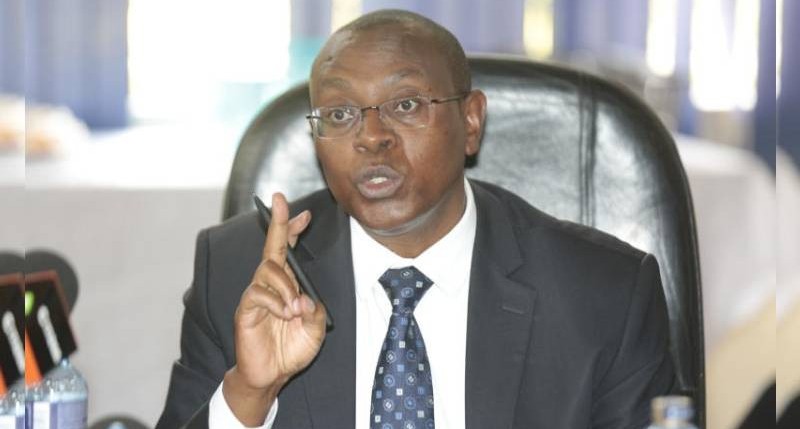
The Kenya National Examinations Council (KNEC) CEO, Dr David Njeng'ere. Photo/The Standard
By Newsflash Writer
The Kenya National Examinations Council (Knec) has rolled out a fresh plan that will allow Kenyans who wish to resit the Kenya Certificate of Secondary Education (KCSE) exam to do so before the 39-year-old system is officially phased out in 2027.
This announcement comes as Knec awaits a High Court ruling on the stalled proposal to introduce mid-year exams, which would have created an alternative examination cycle for repeaters, private candidates, and adults.
The last KCSE cohort under the current 8-4-4 system—students now in Form Two—will sit their final exams in 2027. This group also marked the end of the Kenya Certificate of Primary Education (KCPE) in 2023. The phase-out coincides with the ongoing rollout of the Competency-Based Education (CBE) system, now at the junior secondary level. The pioneer CBE class is currently in Grade 9 and will sit their Kenya Junior School Education Assessment (KJSEA) in November, before transitioning to senior school in 2026.
Final window before phase-out
With just two years before KCSE is retired, Knec is targeting adults and former students who never completed their secondary education to register before the system closes. In an interview, Knec Chief Executive Officer Dr David Njengere stressed that 2027 is the last opportunity to sit the exam under the 8-4-4 framework.
“Whether you sat your first KCSE in 1989, dropped out in Standard 8, or want to repeat one subject, you still have the chance to do it in 2026 or 2027,” Njengere said.
He emphasized that the council is committed to working with stakeholders to ensure every eligible Kenyan has the opportunity to complete their secondary education. “This is a critical moment. If you have unfinished business with KCSE, you have two years to re-sit. After 2027, it will be extremely difficult,” he warned.
Read more: Government launches the Re-Imagine Education 2025 initiative
If a pending High Court petition is resolved in Knec’s favour, candidates may have up to four sittings—in July and November of both 2026 and 2027. The mid-year exam initiative, first announced by the Ministry of Education in January, was suspended after a court ruled that it had not undergone sufficient public participation and could disadvantage learners by reducing preparation time.
Education stakeholders have backed Knec’s appeal for candidates to seize the opportunity. Kenya National Union of Teachers (Knut) First Vice Chairperson Dr Malel Langat said many Kenyans who dropped out should take advantage of the two-year window. “We are reminding them not to waste this chance before the full transition to CBE,” he said.
National Parents Association Chairman Silas Obuhatsa echoed the call, urging the Ministry of Education to support school dropouts in registering. “A KCSE certificate is crucial for both employment and further education. No Kenyan should be left behind,” he noted.
Strengthening exam integrity
Njengere also outlined measures Knec has implemented in recent years to safeguard exam integrity. He said the council is fully prepared to administer the upcoming KCSE, with reforms such as personalized question papers, anonymised marking, and a double collection system for exam materials.
“Since last year, we introduced personalized and perforated papers to ensure security. Candidate names have been replaced with numbers to eliminate examiner bias,” he explained. “Previously, an examiner could identify a candidate, but now scripts are anonymous. This has improved fairness.”
He added that the double collection system, where morning and afternoon papers are released separately, has greatly reduced the risk of early exposure. Over 900,000 candidates are expected to sit this year’s KCSE.
Read more: Over 42,000 KCSE qualifiers shun university courses
Njengere further cautioned against malpractice, warning that results of students caught cheating would be cancelled. “Learn from those before you. If you cheat, your results will be annulled and you’ll have to repeat the exam. These are international standards, as we are members of both the African and global education assessment bodies,” he said.
Last year, Knec nullified results for numerous candidates over irregularities. “Everyone will receive their papers on the scheduled day. Any school caught engaging in cheating will face swift legal action. Let learners prepare properly—why gamble with their future?” Njengere added.
The 8-4-4 system, introduced under President Daniel arap Moi in 1986, has often been criticized for overemphasizing academic exams at the expense of practical skills. The new CBE curriculum aims to address these gaps by promoting competency, flexibility, and learner-centred approaches.
Concerns over the 8-4-4 structure began as early as 1990, triggering evaluations and reforms. With its final phase-out now firmly in sight, Knec insists that every Kenyan who wishes to sit KCSE one last time has a limited but crucial window to do so.


About the Author