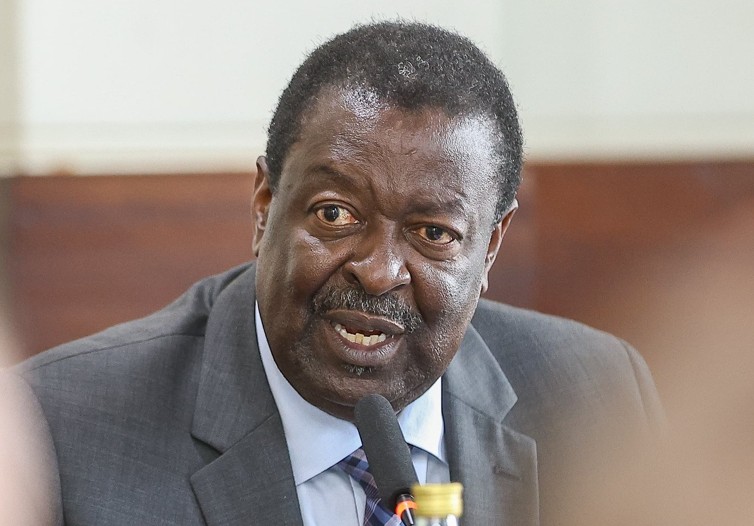
Prime Cabinet Secretary and Foreign Affairs CS Musalia Mudavadi pictured at a previous event. Photo/MusaliaMudavadi/X
By Newsflash Team
Kenya has demanded answers from Tanzania regarding the safety of its citizens caught in the post-election violence.
Nairobi has urged Dodoma to guarantee the protection of Kenyans and act against any violation of their rights. The demand follows reports that many Kenyans in Tanzania are living in fear after being accused of participating in protests that erupted during and after the October 29 general election.
Families in Kenya have raised alarm over missing relatives, with reports indicating that several Kenyans have been killed, injured, or detained by Tanzanian security forces. One family in Nairobi said their relative, a teacher in Dar es Salaam, was allegedly killed, but the body could not be traced. Many Kenyans have also sought help from the High Commission in Dar es Salaam to return home amid the crackdown on foreigners announced by Tanzanian police and President Samia Suluhu Hassan.
Kenya’s High Commissioner to Tanzania, Isaac Njenga, confirmed that any Kenyan wishing to leave was free to do so. President Suluhu, during her swearing-in for a second term in Dodoma, lifted the dusk-to-dawn curfew and restored internet services that had been restricted since the election unrest began.
Mudavadi holds talks with Tanzanian officials
Prime Cabinet Secretary and Foreign Affairs CS Musalia Mudavadi met with Tanzanian Minister for Foreign and East African Community Affairs Mahmoud Thabit Kombo, where Kenya raised concerns over the treatment of its nationals. “We emphasised the need to ensure the safety of all foreign nationals, including Kenyans, who contribute to Tanzania’s economy through business and professional services,” Mudavadi said in a statement.
He acknowledged receiving reports of harassment, arrests, and killings of Kenyans, adding that these incidents have been formally submitted to the Tanzanian government for action.
Read more: Martha Karua deported from Tanzania
As of May 2025, about 250,000 Kenyans were living and working in Tanzania, according to the Ministry of Foreign and Diaspora Affairs.
The Ministry said Mudavadi made it clear that Kenya expects “full protection under the law” for its citizens engaged in lawful activities. Both governments agreed to address any emerging issues through established diplomatic and consular channels in line with international law and East African Community protocols.
Rights groups allege cover-up of killings
Human rights organisations have accused Tanzanian authorities of concealing the true scale of post-election violence. Vocal Africa CEO Hussein Khalid said the group’s contacts in Dar es Salaam were denied access to Mwananyamala Hospital Mortuary while searching for the body of John Okoth Ogutu, a Kenyan allegedly killed during the unrest. “Authorities refuse to disclose where the body has been taken,” Khalid said, adding that their networks estimate between 3,000 and 5,000 people were killed in the violence.
He further alleged that Tanzanian authorities were using Kenyans as scapegoats for police atrocities against local citizens. “Kenyans in Tanzania are being targeted and harassed. The Kenyan government must act swiftly to protect its citizens, especially in Dar es Salaam, Arusha, and Mbeya,” he said.
Read more:Kenyan activists detained in Tanzania after Karua row
Kenya Human Rights Commission (KHRC) Head of Communication Ernest Cornell also said many Kenyans face intimidation and persecution as Tanzanian authorities tighten restrictions. “Businesses are being forced to submit lists of employees, and foreigners — particularly Kenyans — risk losing their work permits,” he said.
The Kenyan High Commission in Dar es Salaam assured its nationals that their safety remains a priority. “The Mission continues to engage Tanzanian authorities to ensure the welfare and security of Kenyans residing in the country,” it said in a statement. Foreign Affairs Principal Secretary Korir Sing’oei added that the government is working to establish the status of Kenyans affected by the unrest before issuing a formal communication.


About the Author