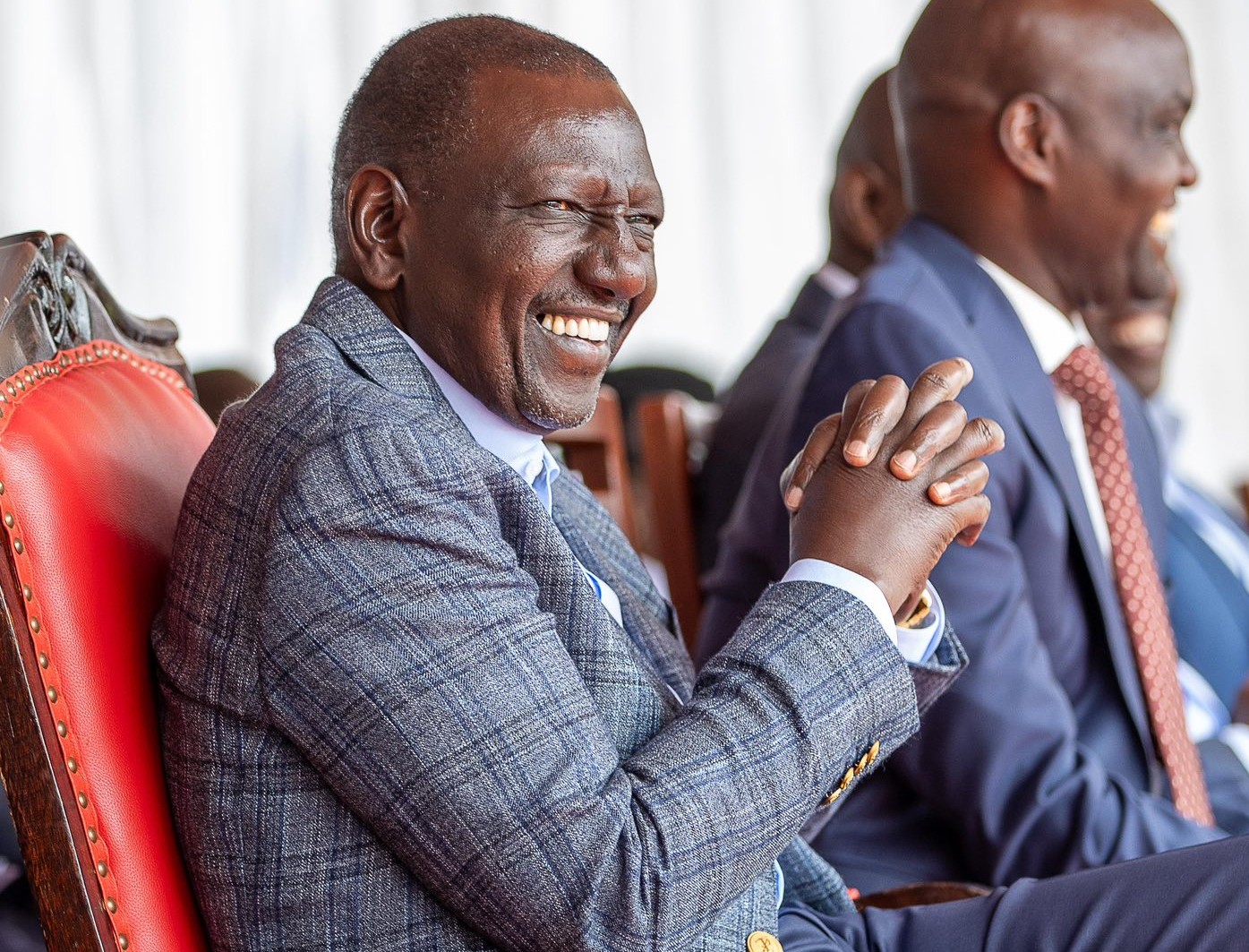
Kenya's President William Ruto. Photo/Capital News
By Newsflash Writer
Billions of shillings collected from foreign travellers visiting Kenya under President William Ruto’s administration were diverted to a Swiss bank account, raising serious concerns reminiscent of the 2014 Eurobond scandal, where funds were routed through offshore accounts to bypass the national treasury system.
An estimated Sh6.5 billion in e-visa revenues was deposited in a Swiss account instead of the Consolidated Fund—the official central account managed by the National Treasury. This fund is governed by strict rules that require all withdrawals to be sanctioned by the Controller of Budget, ensuring transparency and accountability in public finance.
The revelation has triggered renewed scrutiny after former Attorney-General Justin Muturi disclosed that President Ruto allegedly tried to pressure him into approving a direct transfer of $1 billion (Sh130 billion) in environmental grants from so-called “Russian oligarchs” straight to the Ministry of Environment’s account, sidestepping Treasury oversight. Muturi said he refused the request, insisting the funds had to go through the Treasury as required under Section 47 of the Public Finance Management (PFM) Act.
This push to avoid the Consolidated Fund has drawn parallels to the 2014 Eurobond scandal under President Uhuru Kenyatta, when $2.75 billion (Sh356 billion) was channeled into offshore bank accounts. Then Auditor-General Edward Ouko had raised alarms about the lack of traceability of the funds to actual development projects.
The Swiss firm at the centre of the deal
In the most recent case, the government contracted Travizory Border Security SA, a Swiss company, to collect eTA (Electronic Travel Authorization) fees from travelers entering Kenya. Between August 2024 and February 2025, the firm reportedly collected Sh6.5 billion, of which Sh1.5 billion (23%) was paid to Travizory as fees. The funds were routed to a Swiss account rather than the Consolidated Fund, according to information presented to Parliament.
The deal has since collapsed, and the government now says future revenues from such services are being directed to the e-Citizen platform, which links directly to the Consolidated Fund. Still, the structure and secrecy around the previous arrangement have triggered concerns about deliberate attempts to evade fiscal controls.
Muturi also elaborated on his experience, claiming that while in Dubai, he was handed documents to sign that would have facilitated the direct transfer of the Russian grant to the Ministry of Environment—another effort, he says, to bypass the Consolidated Fund.
“It was presented as a $1 billion grant to support the planting of three billion trees as part of the 15-billion-tree initiative. I told them it had to go through the Treasury in accordance with the law. They wanted to sidestep Treasury oversight, yet the funds were foreign,” Muturi recounted.
Legal and oversight concerns
These developments have reignited debates around the integrity and centrality of the Consolidated Fund, whose purpose is to ensure proper oversight of all public funds. The Constitution mandates that all government revenue be deposited into the fund unless Parliament has approved an alternative fund for a specific initiative.
The Eurobond saga remains a significant cautionary tale. Funds borrowed through international bonds in 2014 were received via JP Morgan Chase Bank and Citibank New York, but auditors later reported difficulty tracing the money. A 2019 audit found that Sh53.2 billion from the Eurobond proceeds was never received in Kenya but instead used abroad to pay a syndicated loan. The remaining funds, though brought into the country, could not be linked to any identifiable projects, as they were lumped together with other government revenues.
Read more:Gachagua reveals Ruto’s ‘business deals’ in Sudan, DRC, Serbia
Auditor-General reports also noted that the National Treasury justified the lack of transparency by describing the funds as “fungible,” and revealed that some spending occurred outside the Integrated Financial Management Information System (IFMIS). The Auditor-General recommended that all future sovereign bonds be earmarked for specific projects to ensure proper tracking and accountability.
Experts weigh in
Senior officials and finance experts have reiterated the importance of routing all funds through the Consolidated Fund. Mr Bernard Ndung’u, Director-General of Accounting Services at the Treasury, emphasized that the system exists to ensure control and oversight of public spending.
“The Consolidated Fund is highly regulated. All withdrawals must be initiated by the Treasury and approved by the Controller of Budget. The fund is held at the Central Bank of Kenya, which verifies all approvals before releasing any money,” he said.
Withdrawals from the fund must be supported by formal requests from ministries or state agencies, aligned with the approved annual budget. The Treasury is required to review these requests and publish monthly summaries of receipts and disbursements for public accountability.
Mr Bernard Muchere, a former internal auditor at the National Treasury, stressed that the fund was established to act as a safeguard against misuse.
Read more:Ruto: Gachagua demanded Sh10 billion from me
“The checks and controls in place for the Consolidated Fund are designed to prevent theft or misappropriation. Any attempt to bypass it is often a red flag for irregularities,” Muchere noted.
As scrutiny mounts, these revelations have raised alarms about the ease with which large sums of public money can potentially be rerouted or misused when standard financial procedures are ignored or bypassed. The calls for transparency and adherence to public finance laws continue to grow, especially amid Kenya’s ongoing struggle with rising debt and limited development funding.


About the Author